
10 Best Places to Visit in Skardu in 2026
Before You Go: What You Actually Need to Know About Skardu in 2026 — 10 Best Places to Visit in Skardu
The Skardu tourism story has shifted significantly in recent years. What was once a destination known almost exclusively to serious mountaineers and backpackers has become genuinely accessible; PIA, Air Blue, and Air Sial both fly direct from Islamabad, the road network through Gilgit Baltistan has improved considerably, and accommodation options now range from basic guesthouses to heritage hotels that would hold their own against properties anywhere in the world.
But “accessible” doesn’t mean “easy.” Skardu still demands respect. Altitude sickness affects first-time visitors more often than people expect. Weather can shut down the Skardu Airport for days at a time. Roads that are perfectly fine in June can be washed out or blocked by rockfall in July after a heavy rain event. And the distances between places, which look manageable on a map, take significantly longer to cover on the actual terrain.
Plan for a minimum of seven days if you want to see more than three or four locations meaningfully. Ten to fourteen days is better. And always build buffer days into any itinerary that includes a flight from Islamabad, because those flights cancel more often than airlines would like to admit.
-
Deosai National Park — The One That Changes How You Think About Landscape
If you visit Skardu and don’t go to Deosai, you have left the most important thing undone.
This is not hyperbole. Deosai National Park, declared a protected area in 1993 specifically to protect the critically endangered Himalayan brown bear, is one of the highest plateaus in the world at an average elevation of 4,114 meters. It covers roughly 3,000 square kilometers, which is a number that sounds large on paper but doesn’t fully register until you’re actually standing in the middle of it and the horizon is so far away in every direction that the curvature of the Earth stops feeling like a metaphor.
The plateau transforms dramatically through the summer season. In late June and early July, wildflowers, buttercups, gentians, primroses, and alpine species that have no common English name cover the ground so completely that the plateau looks as though someone replaced the grass with a painting. By September, the flowers have faded and the grass turns gold, which is beautiful in a completely different and equally legitimate way.
Sheosar Lake, sitting at 4,142 meters within the park, is the visual centerpiece, turquoise, vast, impossibly still on calm mornings, and surrounded by a silence so total it becomes almost physical.
Wildlife sightings at Deosai include the Himalayan brown bear, Tibetan red fox, golden marmots, bar-headed geese, and, on very rare occasions, evidence of snow leopard activity in the rocky margins of the plateau.
Getting there: 3 to 4 hours by 4WD jeep from Skardu City, passing through Sadpara Lake on the ascent.
Best time: Late May through mid-September.
Spend at least one night camping on the plateau if your itinerary allows it; the stargazing alone justifies the effort.
-
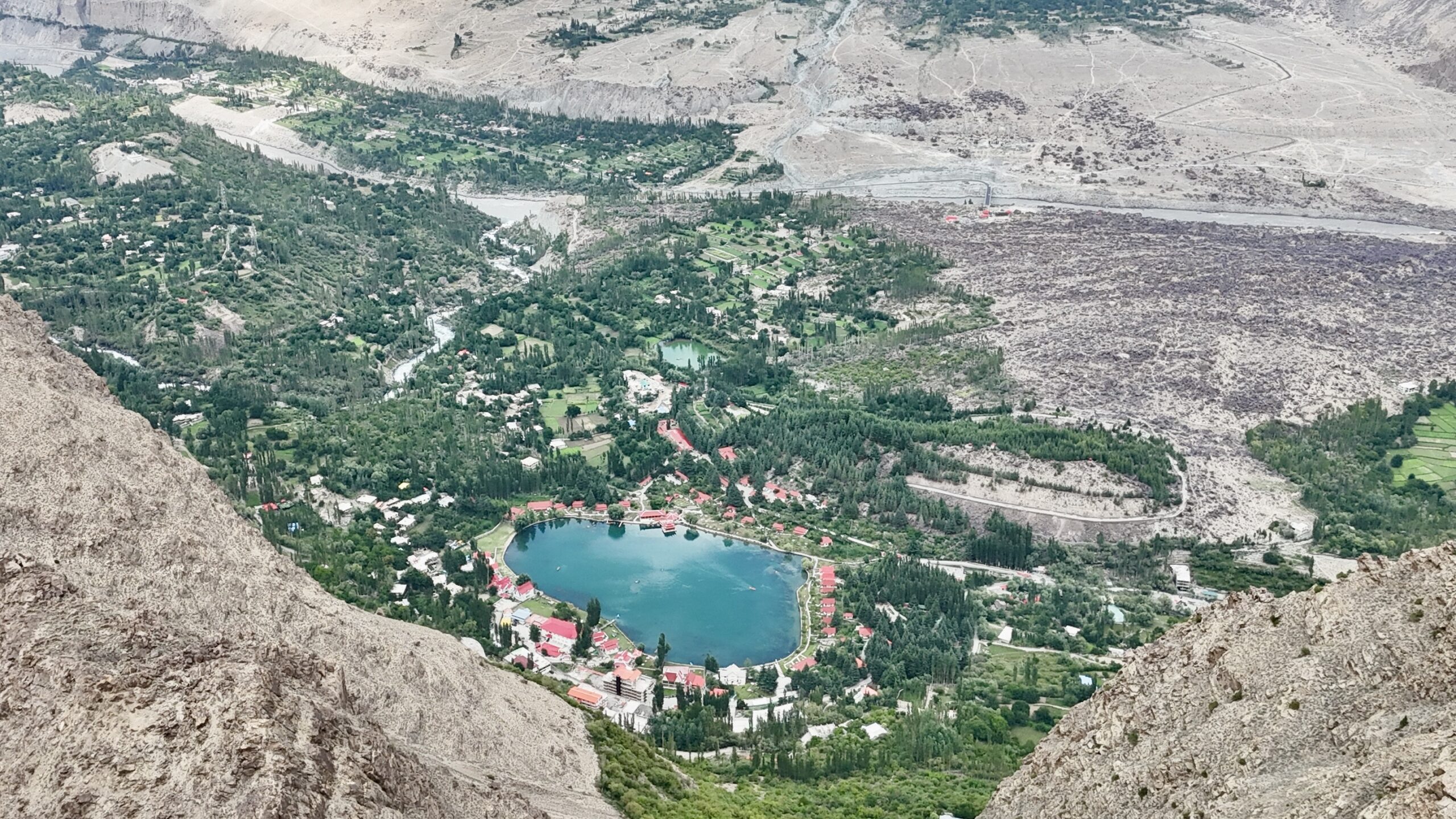
Shangrila Resort and Upper Kachura Lake — The Postcard That Actually Exists
There are photographs of Upper Kachura Lake the ones with willow trees growing directly
over still turquoise water that circulates so widely across Pakistani travel content that by the time you actually arrive, you’re half-convinced it won’t look real. It does look real. It looks exactly like that, and the photographs aren’t even its best angle.
Shangrila Resort, which has occupied the lake’s edge since the 1980s and takes its name from the mythical Himalayan paradise described in James Hilton’s novel Lost Horizon, was built by Air Marshal Agha Muhammad Asghar Khan and has since become one of the most recognizable landmarks in Gilgit-Baltistan. The main dining hall is housed inside the fuselage of a vintage Dakota aircraft, a detail so unlikely that it works perfectly.
The lake itself, also called Lower Kachura Lake or Upper Kachura Lake, is fed by underground springs and glacial meltwater. It’s colder than it looks. In the early morning, before the day-tripper jeeps arrive from Skardu, the lake surface is mirror-flat, and the reflections of the surrounding mountains in the water are so perfect they’re almost disorienting.
Upper Kachura Lake is about 30 kilometers from Skardu City. Lower Kachura Lake, a short walk from the upper lake, is larger, less photographed, and genuinely worth including; it has a quality of quiet that the more famous lake sometimes loses during peak season.
Best time: June through September.
Getting there: 45 minutes by jeep from Skardu City.
Practical note: Arrive before 9 AM for the best light and the fewest other visitors.
-
Satpara Lake: The One Most Visitors Underestimate
Satpara Lake sits only 8 kilometers from Skardu City, which is close enough that most travelers include it as a casual half-day stop rather than a destination in itself. That’s an underestimation.
The lake is a natural reservoir formed within a rocky bowl at the base of the mountains above Skardu. Its water is deep, significantly deeper than it appears from the shore, and the color shifts through the day from dark navy in the early morning to a deep, saturated blue by afternoon. The Satpara Dam, built at the lake’s outlet, supplies drinking water and electricity to Skardu city, which gives the lake a practical significance that locals feel differently about than visitors do.
What Satpara does particularly well is scale. The rocky walls rising directly from the water’s edge, with very little intermediate terrain between water and cliff, create a sense of enclosure and grandeur that larger, more open lakes sometimes lack. Sitting at the water’s edge in the late afternoon, watching the light work its way down the far cliff face, is one of those experiences that doesn’t make it onto highlight reels because it’s fundamentally quiet but it stays with you.
Brown trout fishing is permitted at Satpara Lake under license, and the lake is known for supporting a healthy trout population. For fishing enthusiasts, this alone is worth the stop.
Getting there: 20 minutes by jeep from Skardu.
Best time: The lake is accessible and pleasant
from April through October.
Practical note: Combine with a morning drive up toward Deosai since the road passes directly by.
-
Kharpocho Fort’s History Sitting Above the River
Skardu has a history that most travel guides mention and then immediately abandon in favor of the landscape. That’s a mistake, and Kharpocho Fort is the reason.
The fort sits on a massive rocky outcrop directly above Skardu city, rising about 120 meters above the valley floor. It was built in the 16th century during the reign of Ali Sher Khan Anchan, the ruler of the Skardu Kingdom, and its name in Balti means “King of Forts,” which tells you something about the regard in which it was held by the people who built it.
The Mughals attempted to take it. The Dogras eventually succeeded in the 19th century. The British surveyed it during the Great Game period. The fort has watched a great deal of history move through the valley below it, and climbing to the top, which takes about 20 minutes on a rocky path from the base, rewards you with a view across the entire Skardu basin, the Indus River, the airstrip, and the surrounding peaks that is simply extraordinary.
The fort itself is partially ruined but structurally present. Several towers, walls, and chambers are intact enough to explore. A small mosque dating to the original construction still stands inside the fort complex.
Getting there: The base of the fort is a 10-minute drive from central Skardu, followed by a 20-minute climb on foot.
Entry: Nominal fee payable at the base.
Best time: Early morning for the best light on the valley view.
-
Sarfaranga Cold Desert: The Landscape That Breaks Your Categories
Pakistan has a cold desert. That sentence still surprises people who haven’t been to Skardu, and the surprise doesn’t fully resolve even when you’re standing in the middle of it.
Sarfaranga Cold Desert sits approximately 30 to 35 kilometers from Skardu city and is a genuine high-altitude desert ecosystem with golden sand dunes, flat sandy plains, and very little vegetation set directly beneath some of the highest peaks in the Karakoram Range. The mechanism that creates it is meteorological: the surrounding mountains block monsoon moisture so completely that the valley floor receives under 200 millimeters of rainfall annually, which classifies it as arid.
The sand came from thousands of years of the Indus River grinding down rock and wind carrying the sediment across the valley floor. The dunes that resulted aren’t enormous; this isn’t the Sahara but they’re real, and the contrast between warm golden sand and ice-covered
The peak directly above is the kind of thing that takes several minutes to process as an actual, real landscape.
Jeep safaris across the dunes are available through local operators and are worth doing not because they’re extreme but because being out in the desert rather than looking at it from the road edge is a completely different experience. Camel rides are also available for those who prefer a slower pace and better photographs.
Getting there: 30 to 45 minutes by jeep from Skardu.
Best time: June through September.
Practical note: Go in the late afternoon for optimal dune photography when the light casts long shadows across the sand.
-
Shigar Valley and Shigar Fort The Place That Earns Its Heritage Status
About an hour’s drive from Skardu city, the Shigar Valley opens up in a way that makes you immediately want to slow down. The Shigar River runs clear and cold through the valley floor. Terraced fields climb the lower slopes above it. Apricot orchards line the lanes between villages, and when the fruit is in season, the trees are so heavy with apricots that branches bend under the weight.
The valley has been inhabited and farmed for centuries, and that human history is palpable in a way that newer tourist destinations can’t replicate: in the irrigation channels cut precisely into the hillsides, in the stone walls that divide the terraces, and in the architectural style of the old houses with their carved wooden balconies.
Shigar Fort is the centerpiece. Built approximately 420 years ago by the Raja of Shigar, it’s a wooden palace constructed in traditional Balti-Tibetan architectural style that was restored over a decade by the Aga Khan Trust for Culture and now operates as a boutique heritage hotel called Serena Shigar Fort. Even if you’re not staying there, rooms are beautiful but not inexpensive. Visiting the fort and its gardens is worthwhile and requires only a small entry fee.
The fort’s restoration is genuinely considered one of the most successful heritage conservation projects in South Asia. What makes it work is that local craftspeople, using traditional techniques and materials, did most of the restoration, which means the result looks like what it is, not like a replica.
Getting there: 1 hour by jeep from Skardu.
Best time: May through October, with July and August for apricot season.
Practical note: The Shigar Fort hotel serves traditional Balti meals that are worth planning around even if you’re day-tripping.
-
Manthokha Waterfall in the Kharmang Valley
It is one of those places that rewards travelers who
are willing to go a little further than the standard itinerary suggests. It’s about 120 to 130 kilometers from Skardu, a 3- to 4-hour drive along the Indus River downstream through Rondu Gorge, and both the journey and the destination deliver.
The waterfall itself drops approximately 60 feet into a natural pool at the base of a narrow gorge. The water is glacial in origin, cold, clear, and carrying the fine sediment that gives it that particular turquoise color that shows up in so many images of northern Pakistan’s water bodies. The pool is deep enough to swim in; local children do exactly that during summer, and the spray from the fall reaches you well before you arrive at the edge.
The Kharmang Valley surrounding the waterfall is relatively undiscovered by mainstream tourism and is one of the more genuine experiences available in the Skardu region, with Balti communities living alongside apricot orchards, farming terraced hillsides the same way their grandparents did, and being hospitable to visitors in a way that doesn’t feel organized or managed.
The name Manthokha translates roughly from Balti as “waterfall of the fairies.” Standing beside it, you’ll understand why someone gave it that name.
Getting there: 3 to 4 hours by 4WD jeep, Prado, or car from Skardu, following the Indus River road through Rondu Gorge.
Best time: June through September, with late June to July for maximum water volume.
Practical note: Start early from Skardu; this is a full-day trip minimum.
-
K2 Base Camp — For Those Who Have Come for the Mountains Themselves
This entry comes with an honest qualifier: K2 Base Camp is not a day trip. It’s not even a weekend trip. The full trek from Skardu to the base of K2, the second highest mountain on Earth at 8,611 meters, takes roughly 10 to 14 days in each direction and requires physical preparation, proper equipment, registered guides, and permits from the Gilgit-Baltistan Wildlife Department.
But for anyone who has come to Skardu specifically because of the mountains because the Karakoram Range is what drew them to Pakistan in the first place, the K2 Base Camp trek is the reason this city exists on the global adventure travel map. The trek passes through Askole (the last village before the glacier), across the Baltoro Glacier, one of the longest glaciers outside the polar regions, at 63 kilometers past Concordia, where four of the world’s fourteen eight-thousanders are simultaneously visible, and finally to the base of K2 itself.
The landscape on the Baltoro is unlike anything accessible to ordinary travelers anywhere else on Earth. That’s not promotional language; it’s a straightforward geographic fact. The scale of the mountains, the scale of the glacier, and the silence of the high-altitude desert around
Concordia creates an environment that climbers and trekkers consistently describe as the most powerful landscape they have ever encountered.
Preparation required: Trekking fitness, altitude acclimatization, quality cold-weather gear, permits, and a registered guide agency.
Season: Late June through August.
Starting point: Askole, accessed from Skardu via jeep through Shigar Valley.
- Blind Lake (Kala Pani): The Hidden Reward for Early Risers
Not every place worth visiting in Skardu has a famous name. Blind Lake, sometimes called Kala Pani Lake, is one of the genuinely hidden spots in the region, sitting high above Skardu city at an elevation that requires a moderate uphill hike to reach.
The lake is small, significantly smaller than Satpara or Kachura, and sits in a rocky depression on the hillside above the city. What makes it worth the climb is what surrounds it: an unobstructed panoramic view across the entire Skardu basin, the Indus River cutting through the valley below, the airstrip, the surrounding peaks, and on clear mornings, the distant shimmer of the Karakoram glaciers.
The hike to reach it takes about 45 minutes to an hour from the trailhead above Skardu city, gaining several hundred meters of elevation over rocky terrain. It’s not technical, but it’s steep in sections and requires reasonable fitness and sensible footwear.
The reward for going early — before 7 AM if you can manage it — is having the lake and the view entirely to yourself. Most tour groups don’t know this place exists. That’s exactly why it’s on this list.
Getting there: Drive or walk to the upper areas of Skardu City and follow the trail uphill.
Best time: May through October, early morning.
Practical note: Confirm the current trailhead with your guesthouse; local knowledge here is more reliable than online maps.
-
Basho Valley — The Short Drive That Feels Like a Different Country
Basho Valley sits roughly 45 to 60 kilometers from Skardu City in the direction of Gilgit, and it’s the kind of place that makes you reconsider how you’d been thinking about the entire region.
The valley is green, genuinely, deeply, almost implausibly green in a way that contrasts sharply with the rocky, arid landscape of the Skardu basin. Pine forests cover the upper slopes. Wildflowers grow along the valley floor. A clear stream runs through the middle of it. The air is noticeably cooler and more humid than in Skardu City.
The local community in Basho operates a simple eco-tourism setup: basic accommodation in wooden rest houses, guided walks through the forest, and meals made from locally grown produce.
It’s not luxurious. It’s not supposed to be. What it is, is a genuinely quiet corner of Gilgit-Baltistan where the natural environment is intact, the pace is slow, and the experience of being in a living mountain landscape rather than a famous viewpoint is the entire point.
Basho Valley is where you go when you’ve spent several days absorbing dramatic scenery and you want something that simply feels like peace.
Getting there: 1 to 1.5 hours by jeep from Skardu toward Gilgit, then a turn into the valley.
Best time: May through September.
Practical note: Overnight stays in the valley are strongly recommended over day trips; the valley’s personality changes completely after the day-trippers leave.
Practical Information for Visiting Skardu in 2026
Getting to Skardu
By Air: PIA, Air Blue, and Air Sial operate flights between Islamabad’s Benazir Bhutto International Airport and Skardu Airport (KDU). Flight time is under one hour. Seats in summer fill quickly; book 2 to 4 weeks in advance. Weather cancellations are frequent, particularly during monsoon season (July to August). Never book a tight onward connection from Skardu.
By Road: The Karakoram Highway from Islamabad to Skardu covers approximately 700 kilometers. Budget 18 to 22 hours of driving, ideally split over two days with an overnight in Chilas or Gilgit. The road passes through some of the most spectacular gorge scenery in Pakistan. NATCO and private coach services operate this route, or you can hire a private vehicle.
Where to Stay in Skardu
Luxury: Shangrila Resort (Kachura), Serena Shigar Fort (Shigar Valley),
Mid-range: Mashabrum Hotel, Concordia Motel, several well-regarded guesthouses in Skardu city
Getting Around Skardu
4WD jeep hire is the standard transport for everything beyond the city. Book through your hotel, a registered local tour operator, or the Skardu Jeep Drivers Association for reliability. Always agree on the full itinerary and price before departure.
Money and Connectivity
ATMs are available in Skardu city (Bank of Punjab, HBL, and MCB branches). Beyond the city, carry cash. Mobile coverage is provided primarily by Telenor, Zong, and SCO (Special Communications Organization). Other networks are unreliable in much of Gilgit-Baltistan. Download offline maps before leaving the city.
Health and Altitude
Skardu sits at 2,228 meters above sea level. Most visitors acclimatize without serious difficulty, but spending your first day in the city before heading to higher elevations is strongly advised. Headaches and fatigue are normal in the first 24 hours. Deosai, at 4,114 meters, is a significant jump; be honest with yourself about symptoms before ascending. Carry ibuprofen, antihistamines, and basic first aid supplies.
How to Structure a Skardu Itinerary in 2026
For the best and most comfortable tour, contact us at “Skardu Tour.” The company has a government license and 10 years of experience.
A Final Word on Visiting Skardu Responsibly
North Pakistan’s tourism sector is in a genuine growth phase right now, and that growth is a double-edged reality. The economic benefits to local communities are real and significant. Jeep drivers, guesthouse owners, guides, porters, food suppliers, and craftspeople all depend on tourism in ways that were not true twenty years ago.
But the pressure on infrastructure, natural environments, and local social fabric is also real. Roads that weren’t designed for tour convoys are carrying them. Rubbish is appearing in places it didn’t use to appear. Prices are rising in ways that benefit some community members more than others.
The most useful thing a traveler can do in 2026 is be deliberate. Hire local guides and drivers rather than bringing outside operators from Islamabad. Stay in locally owned accommodation. Take your rubbish out of every natural area you visit. Ask before photographing people. Pay fairly without grinding every interaction into a negotiation.
The mountains will outlast all of us. The question is what condition we leave them in for the next person and the person after that.
Frequently Asked Questions
What is Skardu famous for?
Skardu is the gateway city to some of the world’s highest peaks, including K2, and is surrounded by natural attractions, including Deosai National Park, Shangrila Resort, Satpara Lake, and the Sarfaranga Cold Desert. It’s the main base for K2 and other Karakoram trekking expeditions.
When is the best time to visit Skardu?
June through September is the primary tourist season. July and August are peak months with the most reliable road access. Late June to early July is ideal for wildflower blooms at Deosai. September offers cooler temperatures, autumn color, and fewer crowds.
How many days are enough for Skardu?
A minimum of five days is needed to cover the major highlights meaningfully. Seven to ten days allows for a fuller experience, including Deosai, Shigar Valley, and Manthokha Waterfall. Two weeks or more is ideal if you’re planning any significant trekking.
Is Skardu safe for tourists in 2026?
Yes. Skardu and the broader Gilgit-Baltistan region are considered safe for both domestic and international tourists. The local tourism infrastructure is established and welcoming. Standard travel precautions and altitude awareness apply.
Can I visit Skardu in winter?
Some parts of the city itself remain accessible in winter, but most natural attractions, Deosai, Sarfaranga, Manthokha, and remote valleys, are either inaccessible or unsafe. Winter is not recommended for first-time visitors.
Planning your Skardu trip for 2026? Leave your questions below, whether it’s about specific places, itinerary help, or budget planning. Practical advice, not generic answers.
